
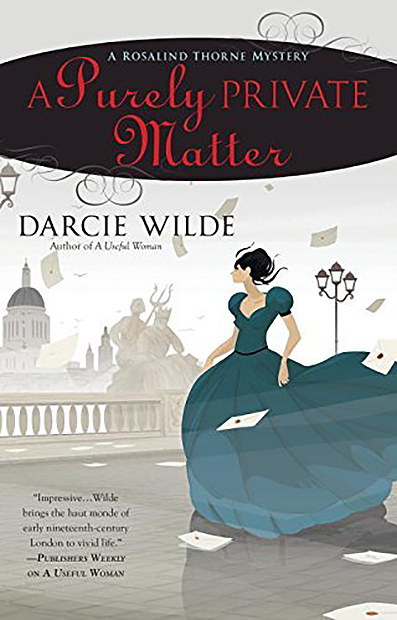
A PURELY PRIVATE MATTER: A ROSALIND THORNE MYSTERY (BOOK 2)
BOOK DESCRIPTION
The Rosalind Thorne Mysteries—inspired by the novels of Jane Austen—continue as the audacious Rosalind strives to aid those in need while navigating the halls of high society…
Rosalind Thorne has slowly but assuredly gained a reputation as “a useful woman”—by helping respectable women out of some less-than-respectable predicaments.
Her latest endeavor is a tragedy waiting to happen. Desperate Margaretta Seymore is with child—and her husband is receiving poisoned pen letters that imply that her condition is the result of an affair with the notorious actor Fletcher Cavendish. Margaretta asks Rosalind to find out who is behind the scurrilous letters. But before she can make any progress, Cavendish is found dead, stabbed through the heart.
Suddenly, Rosalind is plunged into the middle of one of the most sensational murder trials London has ever seen, and her client’s husband is the prime suspect. With the help of the charming Bow Street runner Adam Harkness, she must drop the curtain on this fatal drama before any more lives are ruined.
- Publisher : Penguin Publishing Group
- Publication date : May 2, 2017
- Language : English
- Print length : 385 pages
- ISBN-10 : 0425282384
Buy the Book
Coming in 2026
Read an Excerpt
A PURELY PRIVATE MATTER — A ROSALIND THORNE MYSTERY
by
Darcie Wilde
READER’S SAMPLE
Chapter One — The Art of Obtaining Discreet Entry
Avoid as much as possible going out in the evening, especially on frivolous errands.
—Samuel and Sarah Adams, The Complete Servant
How will you get inside? Mrs. Devery’s question echoed in the back of Rosalind Thorne’s mind as she climbed out of the hired carriage. They do not admit women at Graham’s.
That was the first problem. Had Rosalind needed to get inside a respectable house, she could have followed the daisy chain of her acquaintance to find a plausible reason for visiting. There were, however, limits to even Rosalind’s carefully cultivated connections. Fashioning an anonymous admission to one of the most exclusive gaming clubs in Pall Mall had proved beyond her powers, until tonight.
Tonight Graham’s was holding its Selenite Ball. Once a year, the club members welcomed London society’s richest and most riotous inhabitants. Champagne and brandy would flow and tables would groan under the weight of the food prepared by the club’s French chef, and most important for Rosalind’s purposes, women would be welcomed into the club’s exclusively masculine preserve.
Rosalind clutched her blue silk cloak closed with one hand and held her white and silver face mask with the other as she shouldered her way through the opulent crowd. Ladies and gentlemen done up in enough colors to outfit a hundred stained glass windows jammed the steps. Precious stones, some of which were surely genuine, sparkled on every throat, bosom, and brow. Rosalind was not the only woman to affect a mask. Creations of gold lace and peacock feathers adorned the faces of some who did not scruple to expose their shoulders, arms, bosoms, and most daringly, their ankles.
Graham’s club had three sets of doors facing St. James’s Street, and all of them stood wide open in an attempt to accommodate the flood of fashionable visitors. Rosalind selected the doors farthest to the right, and inserted herself into the particolored current with the efficient yet unobtrusive sidestep she’d perfected for navigating crowded ballrooms.
When she reached the golden doorway, the liveried footman shook his head at her until all his chins wagged. “Now, then, ma’am, I will need to see your invitation.”
Rosalind was as devoid of invitation as she was of any intention to join the festivities. She stepped closer to the footman and, in a familiar manner that would have shocked any respectable house or manservant, took his hand.
“I am here to meet a friend,” she breathed as she pressed the coin into his palm.
The man looked at her mask, and closed his hand around the coin. He also stepped back, and bowed deeply. Rosalind gathered her hems and sailed past him with a straight back and smooth step that would have made her old deportment master smile.
How will you know where to go? Mrs. Devery had asked. You will not know what the place looks like inside.
This much, at least, was easy to solve. The circulating library kept a number of guidebooks describing the more notorious sights and haunts of London. The article in Clubs of the Metropolis: A Comprehensive Guide had proved most detailed. Rosalind looked about her now, matching that description to what she saw.
Dozens of flambeaux and beeswax candles lit Graham’s marble entrance hall. A pair of brightly rouged women in low-cut gowns of pale green silk glanced curiously at Rosalind, but did not pause as they joined the shining river that flowed up the famous (according to the guidebook) marble and gilt stairs. On either side of that sweeping stairway stood a pair of poorly executed, larger-than-life gilded statues of naked women. They were crowned in stars and holding aloft fans of playing cards in one hand while the other beckoned the members to come try their luck. These were meant to be representations of the goddess of fortune. Privately, Rosalind thought the goddess of fortune should have a word with her solicitor.
But surely you’ll be recognized.
That had been a genuine worry. Graham’s counted many sons of aristocratic families among its members. Rosalind could not risk being seen unescorted in a place she had no business even entering. That meant not one, but two, disguises became necessary, the first to get her through the door, and the second to render her invisible once she was inside. It also meant that she could not make use of the attended cloak room or retiring room to effect her transformation. But as she had hoped, behind each of the great, gilded statues, there was a narrow, shadowed space that was simple enough for Rosalind to fade into.
Keeping her motions small and quick, Rosalind drew off her mask and unfastened her cape. Underneath, she wore a plain black dress. The addition of a white collar and plain cuffs made the garment originally designed for mourning into a passing imitation of a lady’s maid’s severe dress. She had pulled her golden hair into a simple knot at the back of her neck, and left off even the most modest pins or jewels. Instead of a reticule, she carried a plain work bag for holding thread and scissors, scraps of lace, and other needlework.
Presto! thought Rosalind to herself as she smoothed the cloak over her arm.
It was not as easy to imitate a servant as one might be led to believe from stage plays and three-volume novels. In addition to the thousand highly specialized forms and skills that a life in service demanded, there were habits of motion and attitude that were as difficult to assume without training and continual practice. Therefore, Rosalind had waited until after midnight to make her attempt. By now, the majority of the guests were quite drunk. The rest were concentrating on getting drunk, or taking advantage of others’ drunkenness. Under these circumstances, the finer details of her dress and demeanor ought to pass unnoticed.
Rosalind slipped into the very edge of the crowd and let herself be carried by mutual motion up the stairs. If anyone asked what she did here, which was unlikely, she could say she was taking the silk cloak to her mistress, who wished to leave without delay.
Rosalind reached the first floor. Clarence blue carpets softened the floors. More gilded statues in the style of those downstairs guarded the entrance to a hive of galleries and salons. Music and laughter filled the whole building as men and women danced and drank and crowded around the tables. The new game of la roulette was also on full display and, to judge by the cheers thundering through the gaming rooms, was proving a magnificent success.
Rosalind turned her face away from that gaudy door. Fortunes would be lost tonight. Women as well as men would be swept up by the excitement, and they would commit sin and folly to be allowed to continue to play. It was that sort of folly which brought her here tonight, and what she needed was not to be found on this floor. Rosalind breezed past the gaming rooms, making her way to the plainer stair at the end of the passageway.
I am at my wits’ end, Miss Thorne. You must help me.” Mrs. Percival Devery, née Lucille Allenby, had cried as she sat in Rosalind’s small parlor and poured out her story.
Rosalind Thorne had a reputation as what society called “a useful woman.” Usually, this referred to some gently bred woman in distressed circumstances who managed to keep a kind of position in the fashionable world by helping her better-off sisters organize their visiting lists and entertainments, as well as running those errands that these more fortunate women found too fatiguing.
But recently and singularly, Rosalind had enlarged upon her occupation. She had begun to help women with their more serious problems. The problems that could affect lives, marriages, and families.
Rosalind listened to Mrs. Devery’s halting description of how she had come to this city as a new bride and how her husband had introduced her to society. Society, in its turn, had introduced Mrs. Devery to cards. She quickly took to the games, and enjoyed them enough that she found herself playing deeper than her income allowed. In order to keep playing, she had borrowed money from a man named Russell Fullerton.
He was so charming. So understanding, Mrs. Devery told Rosalind miserably. If I had known what kind of man he was, if I had any idea . . .
But no one among her new acquaintances had thought to warn her. Not even when Mr. Fullerton had asked her to give him her cameo brooch as a promise that she would repay his loan. But although she did repay him, the brooch had not been returned. Then, the letters had started to come, and the demands for more money began.
And you have been paying?
I have, or at least I have tried, but he wants so much, Miss Thorne.
Rosalind mounted the narrower, quieter stair that led to the club’s second floor with a firm step.
My advice, Mrs. Devery, is that you tell your husband the truth. If he cares for you, he will forgive you.
Mr. Fullerton has threatened to take the story to the papers. My husband is in the House of Commons, Miss Thorne. The scandal would destroy his career. He would not forgive that.
The hallway of the second floor was deep in shadow. The windows at either end admitted some flickering light from the street outside, but no candles had been lit here to alleviate the dark or the cold, because no one was expected to be up here this early.
Like most clubs of its kind, Graham’s kept rooms that could be reserved by those who had no wish to bother traveling London’s streets to get to their tables. Some gentlemen, in fact, lived almost exclusively at their clubs, either for the convenience of the location, or to avoid the entanglements of hearth and home. Mr. Fullerton was one of these. Rosalind had bribed Graham’s servants for information well before she ever set foot in the club. A glass of gin and a few coins had enabled her to discover that Mr. Fullerton occupied the corner suite on the second floor.
Rosalind kept her gait steady as she moved down the darkened and silent corridor. To look furtive would be the greatest folly. She must act as if she was under orders to be in this exact spot.
She reached the door that should lead to the corner apartment, and stopped in the puddle of orange light that flickered through the arched window.
This point had always been the weakness of the plan and the question for which there was no answer. Was the door locked? It might not be. Mr. Fullerton was in the club, after all, down in the gaming rooms, enjoying the rout and riot. But then, he was a blackmailer and therefore not a trusting soul. If he’d locked his door, then Rosalind would need to find where the housekeepers stored the keys. That would take her into the realm of the servants, which would be risky beyond measure. The masters might all be drunk and distracted tonight, but their attendants most certainly were not.
But she glanced at the floor and saw a bright line of light gleaming at the level of the carpet. There was a fire in the room. That might mean the door was open, but it also might mean that there was someone in the rooms. Rosalind’s heart thumped once, but she did not permit herself to hesitate. She knocked softly, as a servant alerting those within she was about to enter.
There was no answer.
Rosalind’s heart thumped again. She closed her hand around the doorknob. It turned, and the door opened quietly. Rosalind resisted the urge to dart inside, but kept her movements sedate, at least until she closed the door behind herself, and drew the bolt.
He told me he keeps my cameo in the drawer of his bedside table, so that he has it near him always.
Mr. Fullerton would have had no fear of divulging this little detail to Mrs. Devery. A young lady of her class would never be admitted into a gentlemen’s club, much less his private rooms. Except for one reason, of course, and Mrs. Devery had been painfully aware of this.
I think . . . I think he may eventually demand more from me than money.
Mr. Fullerton clearly reveled in his high living, and Rosalind felt certain he must have had these apartments privately furnished. Despite the display of gilt and excess downstairs, Rosalind could not believe that the club provided all its members with such a profusion of silks and velvet, marble tops and painted enamel handles.
A beautiful little marquetry table waited beside a luxuriously curtained bed. Rosalind put her hand to the ornate drawer, and held her breath.
The drawer didn’t budge. Mr. Fullerton, it seemed, was not entirely careless.
Rosalind bit her lip and quickly reached into her work bag to pull out the sandalwood letter opener she’d brought against this possibility. Rosalind had been gently reared, but some of that gentle upbringing had included a girl’s boarding school, a place where one might gain experience with all manner of petty larcenies.
Rosalind’s hands had not lost their touch, and Mr. Fullerton’s drawer proved no more difficult than the headmistress’s desk had. When she slid it open, she found half a dozen articles of jewelry in that drawer. Rosalind saw a garnet ring, a pearl collar, and a figured brooch. Mrs. Devery had clearly not been Fullerton’s only victim.
There were also several packets of letters tied in silk ribbon.
“Did you send him any letters?” Rosalind had asked Mrs. Devery. “Any at all, even a brief note?”
“No. I did not. Everything was communicated through my old nurse. She is still as sharp as she ever was, and . . . is sincerely attached to me.”
It would seem, however, that there were other ladies who were not so careful. Still, those letters were not Rosalind’s business. She was here for the white and sepia cameo that was a portrait of Mrs. Devery’s grandmother, framed in gold and tiny diamonds.
Before she began to plot her entry into the club, Rosalind had visited Mrs. Devery’s jeweler. That careful artisan had kept the description and pattern of the cameo. Many ladies had copies of their jewels made so that the originals could be stored for safekeeping, or sold without their families being the wiser. The jeweler was quite happy to duplicate the cameo in paste and resin, and did not demur at the alterations Rosalind requested.
Now, Rosalind claimed the original cameo and, in its place, dropped the copy from her work bag into the drawer. She looked again at the packets of correspondence, and hesitated. Then, she took up the letters and tucked them away as well. She closed the drawer. There would be no way to relock it, but that could not be helped. Hopefully, Mr. Fullerton would think his thief had just been after the letters, and not consider the jewels left behind.
There. Done. As long as she could manage her exit.
Rosalind slipped once more into the hallway. She strained her ears for the sounds of bells or the cry of the watch for some indication as to the time, but heard neither. It was a far different sound that broke the cool silence.
“You there!” The woman’s voice stopped Rosalind in her tracks. “Come here and help me fix this thing!”
Rosalind stood paralyzed for a handful of frantic heartbeats before she gathered herself. It was not the command that held her frozen. It was that she recognized the woman’s voice.
Charlotte? she thought, but immediately caught herself. No. It is not possible.
“I must get my mistress her wrap,” she murmured without turning around.
“Never mind your mistress. Come and help me.”
No. It is not her. This voice is too low. The accents are wrong.
Rosalind turned to face the woman who stood at the top of the stairs. The flickering torchlight glimmered on a dress of pale silk and netting. In one hand, the woman held a swath of gauze that had clearly been torn at the shoulder.
Rosalind gathered her nerve, but her answer was cut off by the sounds of footsteps on the stairs.
“There you are, my dear Cynthia!” A slim man with his hair swept back from his forehead trotted up the stairs. “I thought I’d lost you!”
“Ferdinand!” The woman in silver turned at once. Rosalind was so quickly dismissed from all consideration, she might as well have dropped through the floor.
“You frightened me. Feel how my heart beats!” The woman lifted the man’s hand to her breast and laid it there.
Rosalind dropped her gaze. She knew she should retire. If she had been a real servant, she would have known how to retreat and where the backstairs were located. But she was not, and these two blocked her only exit.
“Ah, a thousand curses upon me as a fool,” murmured Ferdinand, stepping closer to the woman, and lacing his arm tightly through hers. “Come, let me find you some champagne. You will drink until you are quite calm again.”
“But my dress!” The woman pulled the torn gauze from her shoulder. “I cannot be seen like this.”
Tenderly, the man took the netting and draped it around her throat, arranging it with great care. “Then I shall take you where you cannot be seen.”
The woman lifted her face to his. They linked arms at once and hurried down the corridor, away from the stairs, and Rosalind, leaving her alone, forgotten, and entirely safe from all risk of exposure.
This fact barely touched her. In her mind Rosalind was miles and years away. She stood in another darkened hallway, watching another young woman—slimmer, more plainly dressed—run through another door. Despair, confusion, and betrayal washed through Rosalind, as clear and sharp as if she were still a girl, on the night when she watched her sister, Charlotte, disappear.
The Importance of Independent Book Shops

IndieBound is a “local first” shopping movement and a network of hundreds of independent bookstores sharing book recommendations and connecting readers and authors.
Independent bookstores have always occupied a special place in communities. Through IndieBound — and the Indie Next List fliers and Indie Bestseller Lists — readers find trusted, bookseller-curated reading options, newly discovered writers, and a real choice for buying.