
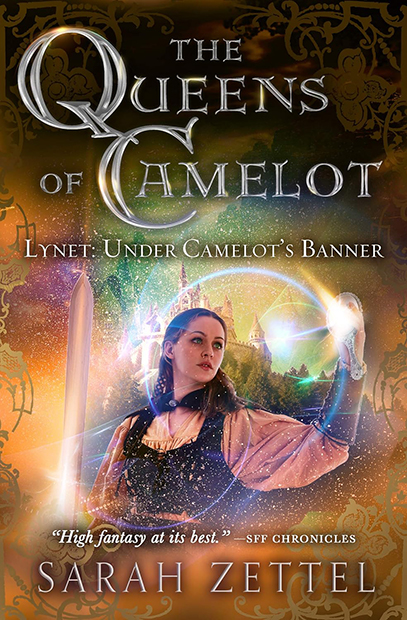
LYNET: UNDER CAMELOT’S BANNER: THE QUEENS OF CAMELOT (BOOK 3)
BOOK DESCRIPTION
The path to Camelot never runs smooth… When war threatens the kingdom of Camliard, sisters Lynet and Laurel find themselves in the heart of the darkening crisis, with only one way to restore peace. While her older sister remains as a hostage, Lynet must bring back the last heir of Camliard’s ancient royal house — the High Queen Guinevere. But Lynet’s quest is not an easy one. In Camelot, she must deal with politics of court as well as country. One ally is Gareth, youngest brother of the brilliant Sir Gawain, who aches to achieve knighthood and fame by his own hand. But Gareth soon finds this quest is no game, and that Lynet is no maid to be toyed with. With the machinations of the sorceress Morgaine threatening their future, only Lynet and Gareth’s strength and love can save the queen’s hereditary kingdom from a tangled web of magic, treachery and war. And that strength is failing…
- Publisher : Wildside Press
- Publication date : April 24, 2010
- Language : English
- Print length : 290 pages
- ISBN-10 : 1434404218
Buy the Book
Read an Excerpt
THE HEIR — A YOUNG QUEEN VICTORIA MYSTERY
by
Darcie Wilde
READER SAMPLE
PROLOGUE
DOVER
1820
#
He’s dying.
Victoire, Duchess of Kent, sat on a hard stool at her husband’s bedside and willed him to keep breathing.
The room was dark, except for the fire that sputtered fitfully in the hearth, trying in vain to match the roar of wind and surf outside; tying also to warm the room, and bring some small chance of life to the man who lay so still in the narrow bed.
The doctor — William Maton — was speaking. Dr. Maton was a fat, pale, bald, fussy man. He had spent the past four days swearing as to the unfailing efficacy of his knives, cups and leeches. Now, he was saying something far different. Victoire’s mind was too dulled by exhaustion to fully translate his English, but she understood his tone. We have done all we can, he was saying, or something like it. Now we must wait. Or something like it. Perhaps there was also something about trusting in a merciful God.
Victoire ground her teeth to shut in the sob that threatened to escape her.
The doctor fell silent, but a fresh noise insinuated itself into the room’s chill — a thin, insistent bawling. The baby, tucked up in her cot in the adjoining room, was crying. She was cold, or she was hungry. Or she simply wished to protest that she was alone in a dark cottage surrounded by a foul winter storm while the man who loved her most in the world was dying.
Drafts curled around Victoire’s neck. She imagined them like the fingers of a ghostly hand. She imagined that hand dragging itself up the quilts to caress her husband’s cheek. To cover his mouth. To stop his breath.
Dr. Maton was speaking again. A second voice answered. That was Conroy, her husband’s equerry and assistant. Victoire had forgotten he was even in the room. Their English whispers fluttered around her ears. Victoire made out “hope” and “strong,” and “hour.” She tried to understand the rest, but it was no good.
She turned her face towards the window, but there was nothing to see. The shutter had been closed. For all the good it did in keeping out the cold, or the sound of the storm.
The baby was still crying. Where was the nurse? Where was Lehzen? Or even Feodra? She would have to do something. Give an order. Make herself understood.
She could not even make herself move.
“Victoire.”
The sound of her name was less than a whisper, but she still heard it. Her heart thumped. Edward’s eyes were open and searching for her.
“Yes, my heart, I am here.” Victoire said in German. She seized his hand. It was hot and light, as if all his bones had already burnt to ash. Or perhaps it was because he had been drained dry of blood. Dr. Maton said he’d only taken a pint this time. It looked to her as if it had been a gallon.
“Victoire,” Edward said again.
“Rest, my heart. You must regain your strength.” She spoke lightly, praying that he would not notice the tears slipping down her hollow cheeks.
Edward had always been so strong, and so proud of that strength. Let all his royal brothers drink and debauch themselves. Let them carouse with their wastrel friends and squander their fortunes. Edward would not follow their examples. He would keep to strict, simple habits, eat a plain diet, and get plenty of exercise. Oh, the sight of him on horseback, or on the driver’s box of a carriage! It was enough to stop any woman’s heart.
Even her heart which had been withered by her first marriage, her two children, her poverty, her fear for her future.
The future Edward saved me from.
He had driven her out of her tiny, trampled German kingdom, all the way to England. She had protested that she was too far gone in her pregnancy to make the journey, but he insisted. Their child must be born on English soil. He did not want anyone to be able to question whether the babe really belonged to him, or that it could very well be the future of English crown.
He had installed them in Kensington Palace, and dared his brothers to protest his right to rooms in the royal residence, especially once the baby — their pocket-Hercules of a princess — was born.
But now where are we?
Fat George squatted in Windsor and rubbed his greedy hands at the bedside of his blind, mad father. He debauched his mistresses, railed against his legal wife, swilled his wines and gambled away England’s treasury. But Fat George lived, and to all appearances, would continue to live.
Freddy, the Grand Old Duke of York, had grubbed under his mistress’s skirts with one hand and stole from the public treasury with the other and died far earlier than anyone had imagined he might.
Silly Billy, Duke of Clarence, walked the streets without remembering to put on his hat, heart-sore for the whore-actress he’d thrown over so he could marry a princess even poorer than Victoire and get himself at least one legitimate heir.
Augustus, the Duke of Sussex had decided to stick a thumb in the eye of the entire family by refusing to marry anyone acceptable, but that marriage had failed. Now he puttered uselessly about the ruin that was Kensington Palace with his collections of clocks and bibles.
And all the while, Ernest — the scarred, half-blind, lecherous, damnable, Duke of Cumberland — leered at his brothers from his wife’s palace in Germany and waited to see which of them fell first.
But Edward? Strong and plain-living Edward had taken Victoire and the children away from London because Fat George would not advance him the money he needed to live there. They had come to this dreary seaside town and huddled together in this tiny hovel of a cottage.
And Edward had gone for a walk in the December rain, and had gotten his feet wet.
That was all. How can he be dying when that was all that happened?
Victoire pressed her hand against her eyes.
And still the baby was crying. And her husband wanted to speak to her.
“Conroy,” she said.
“Yes, your grace?” John Conroy was a tall man with a long face, bright blue eyes and thick, dark hair. Ladies blushed and batted their eyes at him. The more vicious gossips wondered what kinds of services he performed for the duchess now that the king had brought her to England.
“Go see to the baby,” she said. Conroy is a father. He does not fear a nursery. “Go talk to the nurse. See that Feodra and William are still asleep. I…I cannot.”
“Yes, ma’am.”
If he bowed, she did not turn her head to see it. She rinsed the linen cloth in the basin on the nightstand and dabbed at Edward’s forehead. His skin was too dry. His eyes were too bright, and yet his skin was far too pale.
Bloodless.
“You are not crying, Victoire,” he said, in German. He tried very hard to teach her English, but still, they always spoke German when they were alone together.
“No, of course I do not cry,” she lied. “I never do. You know that.”
“I know.” His fingers curled around hers, feather soft. Her heart twisted inside.
“I will show them yet,” he told her. “I have done what they could not. I have found a good wife. I have fathered a healthy child. You and I will take up the crown together, my heart. We will make a place for our Alexandrina Victoria. We will see them all bow their heads to her, and to us. To us.”
Victoire held her husband’s burning hand and willed herself to believe. But if he had been hollowed out by the fever and the bloodletting, she had been made equally hollow by fear. All the belief she could muster did not fill even an inch of her emptiness.
“Now, it may take some little while for me to get better,” he went on. “In the meantime, you may rely on Conroy. He has been with me these many years. I trust him absolutely.”
“Yes, my heart.” She wished he would stop. He was so weak. This talk was doing him no good. But she had not the strength to tell him so.
“And do not let them take our daughter.” By them he meant his family. His mad father, his ridiculous mother, he spidery, spinster sisters and, most of all, his greedy brothers. “They will try, but they only want to turn her against us and use her for their own purposes. You must hold her tightly to you.”
“They will have no chance to take her.” She meant to speak lightly, but her voice broke. “You will be better long before they can do any such thing.”
“Yes, yes. I have promised, haven’t I?” His eyelids fluttered closed.
Dr. Maton was back. He maneuvered daintily around her. She was a duchess after all, and could not simply be elbowed out of the way. Instead, he took himself to the far side of the bed, coming to stand between Edward and the wall. He lifted Edward’s wrist and stared at his watch.
Fresh fear bubbled up in Victoire. As Edward weakened, Dr. Maton was all the hope that she had. He had scarcely left her husband’s bed, ceaselessly battling the encroaching fever with his his knives and his glass cups and his jar of glistening leeches. He was so attentive, so unstinting. She tried to look at him now and believe he had succeeded.
He must succeed. He was all that they had left.
“Well,” said Maton softly. “Well. His fever has increased. Yes. I think we may bleed him one more time.”
“Bleed?” she breathed, ashamed of her weakness, her irrationality. “He surely has no blood left.”
From the way Dr. Maton stared at her, Victoire knew she’d spoken German. But she could not now summon her English.
“Ma’am.” Conroy stepped out from the shadows. “We must listen to the doctor.”
Dr. Maton was staring past her at Conroy, clearly uneasy. Afraid, perhaps the duchess had gone mad with her grief and was spouting gibberish.
Edward’s hand twitched in hers. His eyes were opened again.
“Edward?” she cried.
“Sir?” The doctor bent close. “Sir, we must bring your fever down! I must bleed you once more.”
Edward’s tongue pressed against his lips, trying to wet them. Victoire snatched up the cloth, and rinsed it again and dabbed it against his mouth.
Edward’s eyes closed. He swallowed. Victoire felt her heart creak, like ice in the last moment before it shatters.
“Let it be done,” Edward said in English. His eyes opened, and she saw the spark in them. Her heart cried out with hope, and the pain was worse than despair.
“Conroy,” Edward breathed. “Conroy, look after my wife and my daughter.”
“Of course, sir.” Conroy bowed crisply, like the soldier he was.
Then, in German Edward said. “Fear not, my heart. I am still strong. Maton will drain this fever out of me.” His fingers curled around hers again. “Then, we will show them. You and I, and our daughter. We will show them a true queen, and they will all kneel.”
CHAPTER ONE
KENSINGTON PALACE,
July, 1835
#
“Keep up, Jane, can’t you?”
“I’m trying!” whined Jane Conroy. Perched uncomfortably on Smokey, her plump mare, the girl had already fallen a full length behind.
“It’s a beautiful day!” Victoria tried, even as the wind snatched at her hems and the edge of her bonnet. The chill air smelled of soot, mud and rain. This late in July, it should be hot and dry, but it had been raining for three days straight. As a result, Victoria had been stuck inside. She was not going to waste this clear spell, however brief it might prove. “Don’t you long for a gallop?”
“You mustn’t, your highness.” Hornsby, today’s groom, looked positively panicked. “Your mother would never allow it.”
As if I was not fully aware of that.
But Mama was inside the palace, and Victoria (and Jane, and Clyde) were outside. They had already ridden beyond the gardens’ straight paths and formal hedges. The Round Pond, with its honking geese and suspicious swans was likewise behind them. Ahead was nothing but an unbroken carpet of grass and low hills stretching to the gate that divided the palace grounds from the park beyond.
Prince felt Victoria’s restlessness. He shifted underneath her, letting her know he wanted to run as much as she did.
Jane tipped her head back to look at the lumpish gray clouds that obscured the sky. From the way she screwed up her face, one might have thought they were about to drop down and smother her. Instead, a single raindrop fell, and smacked her in the eye.
“Ouch! Oh!”
Victoria ducked her head and tried hard not to smile.
“We can’t,” Jane mumbled as she wiped at her eyes. “Father will be angry. I promised to bring you back at the first sign of rain!”
She had, in fact. That promise, and Jane’s dreary presence, were the only reasons Victoria had been able to ride out at all today.
It was not fair. But it was all a part of the “Kensington System.” That system dictated how Victoria’s life was to be lived. It required that every minute of her day be accounted for, and, worse, that she never be alone. So, if Mama could not ride out, Victoria was stuck with Jane, or stuck indoors.
She had tried to remain patient today. She had sat dutifully through having her hair done, and stood still while being dressed. She’d attended to her lessons in geography and history, and penmanship, and music (not that this last was any great trial). She’d stayed quiet while Mama inspected her journal, and her books, and examined her tutors as thoroughly as her tutors examined Victoria.
After her journal had been pronounced satisfactory, Mama had gone to confer with Sir John about some one or the other of the plans for the tour of the northern counties they had declared she would undertake in September.
This resulted in Victoria having a rare ten minutes with nothing to do, and only Lady Flora Hastings, and her own governess, Louise Lehzen, watching over her.
And of course, Jane Conroy. Jane slumped sullenly in a chair with her needlework in her lap and a copy book beside her. Jane was hopeless on horseback, hopeless with a needle, or a piece of music, or a sketching pencil or paintbrush. Hopeless in the face of her father’s endless commands.
Victoria tried to muster some sympathy for the other girl. Jane did not want to be here any more than Victoria wanted her and yet, like Victoria, here she was. Today, and every other day.
Victoria had stood in front of the windows with her spaniel, Dash, in her arms. She looked out across the gardens. At least, she tried to. Streaks of grime obscured the view. When she was six, she’d been asked what she wanted for her birthday. She’d answered that she would like to have the windows washed. She remembered the startled faces of the adults around her, and their nervous laughter.
But nothing had come of it. Victoria had received dolls and books and an enamel brooch rather than what she actually wanted. The sunlight — when there was any — remained blurred by a film of dust and soot. The view — what there was of it — turned into a spoiled watercolor of green and gray, so that the whole apartment remained gloomy even on the brightest of days.
Even Dash knew it wasn’t right. He whined softly and pawed at the window.
You want to be out too, don’t you? She kissed the top of his head.
It was true that Kensington Palace was a palace. It was huge, filled with rare and precious things, and housed a changeable cast of persons belonging the royal family. It was also true, however, that the doors creaked and stuck; that mice had nibbled the edges of the fine carpets, and that damp bloated the tromp d’oiel murals lining the king’s staircase until the painted faces of the people depicted there bulged and cracked.
Mama told her that when they first arrived, there had been mushrooms growing in their rooms. As a very little girl, Victoria had been fascinated by the idea. It made her think of fairy rings. She’d hunted for mushrooms in all the corners, but she only ever found shadows and spiders, and blossoming stains of thick, black mold.
Do not let yourself be fooled, Victoria, Mama told her (and told her, and told her). We are lodged in this dingy hole because his family hates me, and they hate me because I will not let them get hold of you. You will never be their hostage and plaything, romping about with their bastards and cronies until you are spoilt as rotten as the rest.
“Enough,” muttered Victoria to herself. She could not, she would not, stand here anymore, waiting for the next instruction, order or direction.
Victoria hugged Dash quickly. Then, she faced the room.
“I shall go for a ride,” she declared. “Prince needs the exercise.”
“Certainly not in this weather, ma’am!” cried Lady Flora, as shocked as if Victoria had suggested she was going to dance naked in the gardens. “You mustn’t think it.”
Jane Conroy just pulled a face. “It’s going to rain.”
“Not for hours yet.” said Victoria, as if her words could make it true.
“Shall I go speak with your mother for you, ma’am?” asked Lehzen.
Victoria imagined saying She is busy with Sir John. I will only be gone for a little while. She would then simply go into her dressing room, have the waiting maid bring out her habit, and give orders that the groom saddle Prince and bring him to the courtyard. It was what another young women might do. Other young women could move without asking permission, and without hands to hold.
Hands to hold them back. Hands to keep them from going anywhere at all.
Because those other young women were not Princess Victoria, heir to the throne of the United Kingdoms. If she left these rooms without Mama’s permission, there would be a scene, and she would be locked into her boudoir for days.
Sir John and I are only trying to protect you.
“You need not bother, Lehzen. I will go to her myself.”
“What is it Lehzen need not bother with?”
Victoria started. She could not help herself. Mama had returned.
Victoire, Duchess of Kent — Mama — was a tall, elegant woman. How could I have such a short, plump little girl, hmmm? It is the influence of your father’s blood. Her dark hair fell in dramatic ringlets, much thicker than Victoria’s own blond hair. Sit still, Victoria. You cannot be seen with your hair hanging down like a wild thing. What will people think of you? She had wide-set eyes that could take in every detail of a room, or a person, with a single glance. Pay attention, Victoria. If the Dean sees you drift away in the middle of a conversation, what will he think of you?
Dash squirmed in Victoria’s arms and she set him down. He immediately ran for his basket and wriggled under the blanket. It was as if he could already sense a very different sort of storm coming.
“Victoria why are you standing there?” Mama’s voice could contain equal amounts of weariness and anger. It was her finest accomplishment. “Come away at once. How many times have you been told not to linger about in front of the windows? What if someone on the road was to stop to gawp at you? What would they think?”
“They might think that I am looking to see if the weather is good enough to go out for a ride,” Victoria replied. “Prince needs the exercise and I have finished my journal, and my letters.” And my workbooks, and my piano practice and…
“No, Victoria,” said Mama. “It is a foul day. What if you got wet and took cold? Besides, we must make sure you are prepared for the dinner. Prince Lichetenstein in particular should see you at your best. You are aware that he will report on your behavior to —”
“I will just go around the grounds,” said Victoria. “I will be no more than one hour. It will not rain before then, and I will be back in plenty of time for you to quiz me for the dinner.” Again.
“I said no, Victoria. Now, come along.” Mama held out her hand for Victoria to take. Under the Kensington system, Victoria could not walk anywhere alone. Especially not down the stairs. She must be held. She must be steered. She must be managed, and instructed and ordered.
But she had been kept inside for three days by the rain, and this might be her only chance for some air.
“I will go riding, Mama. I will not stay here so you can listen to me recite the names and histories of your dinner guests for the hundredth time.”
Mama leaned down and gripped Victoria’s chin in her strong, white fingers.
“I see what you have been doing.” Her breath was hot and smelled of Madera wine and licorice. “You have been standing here, idle, staring out windows, rehearsing all your wrongs. Disparaging your mother to your governess, to your ladies, and your friend.”
“Jane is not my friend,” Victoria forced the words through clenched teeth. Mama’s grip hurt her. She should be still.
I will not be still.
“Jane comes because Sir John makes her, and you let him,” Victoria grated. “It is not fair. I would never treat anyone in my family so poorly!”
Mama’s grip on Victoria’s chin tightened. Dash poked his nose out from under his blanket and barked, once.
“I did warn your highness.” Lehzen murmured under her breath.
Mama’s head jerked up. Her grip loosened. Victoria twisted her chin away. Dash slid out of his basket and scampered to her side.
“What did you say, Lehzen?”
“I beg your pardon, ma’am.” Lehzen lifted her own chin, as if she herself was a duchess, rather than the daughter of a Prussian schoolmaster. It was an attitude that never failed to infuriate Mama. “It’s only that I had already told her highness that an outing on such a day would be quite inadvisable.”
“Well, yes, I am sure I am always grateful for your advice in how to best care for the health and safety of my child!” Mama’s words oozed condescension, and a thick, oily suspicion. “You may say that you warned her, but I know your ways. I’m sure it was you who put this notion of a ride into her head!”
“This is not Lehzen’s idea!” shouted Victoria. Dash pressed closer against her shin. “You will not blame her!”
“Well, now. What is this?”
Sir John breezed into the room. Jane immediately looked around her in panic, clearly trying to discover what she should have been doing. Mama, however, plunged into an attitude of dramatic relief.
“Victoria is determined to go riding!” You say it as if I had been planning to burn the stables down. “She has been plaguing me this half hour!”
“I did tell her that riding on such a filthy day was not to be thought of, Sir John,” said Lehzen. “But she has insisted she will go out with Jane.”
It was of course entirely wrong that Lehzen should lie to Mama, or to Sir John. But now she had, and — Victoria could not help but note — Lehzen’s addition of Jane to the story made Sir John smile.
Sir John Conroy was a tall, lean man with a wealth of curling black hair. His eyes were a brilliant blue color that showed every emotion that flitted through his mind. Or rather, he could make you believe that they did. That, in turn, made people of all stations want to trust him. Some because they believed he was open-hearted. Some because they believed they could keep ahead of him.
But neither thing was true. Victoria watched him, and she knew better. When he was not exerting himself to charm, Sir John’s clear blue eyes examined the person in front of him carefully, seeking weaknesses he might expose. His seemingly easy smile was in reality an expression of his smug satisfaction. It sent chills down Victoria’s spine that were far worse than when he frowned.
“Well, I see no harm in it, ma’am, if her highness will take Jane.” As he looked to his daughter, Sir John’s smile stretched to show his teeth. “She’ll make sure they return at the first sign of rain. Won’t you, Jane?”
Jane looked as if she would rather be banished to the Outer Hebrides. But she got to her feet, her gaze pointed resolutely at the floor.
“Yes, Father,” she murmured.
Dash growled louder. Sir John’s head jerked around. Dash barked. To Victoria’s horror, Sir John drew his foot back, just a little, just enough to aim a kick.
Heart thumping, Victoria snatched Dash up in her arms. Sir John seemed to recollect himself, and he smiled.
“Yes, I think a ride, with Jane, would be very beneficial,” he said.
He pretended nothing had happened, but Victoria watched, and she saw and she would not forget.
But that was all before. Now, she was out of doors in the fresh air. Prince trotted determinedly across the green. Dash barked happily and nosed about the grass, far too smart to get himself in the way of the horse’s hooves. A raindrop thumped against the back of Victoria’s glove. Another smacked Prince’s head, causing him to shake his ears.
“We need to go back,” whined Jane. “Papa will be furious we were out this long.”
Your father maybe, thought Victoria. My father was a horseman. My father would have loved to ride with me.
Her father also died from a chill he’d caught in the rain. Another drop hit the edge of Victoria’s bonnet, and another. Victoria had been told the story a thousand times. A hundred thousand. The recitation had taken on the shape of catechism. Only instead of saving her soul, it was meant to keep her trembling indoors when the weather turned gray.
The thought of those hundred thousand lectures dissolved the last of Victoria’s patience.
Prince snorted. As if it was the starting gun, Victoria slapped his dappled flank with her crop. The gelding laid his ears flat and sprang forward.
“Ma’am, no!” cried Jane.
“Your Highness!” wailed Hornsby.
But they were too late. Prince was fast, and Victoria could ride him to the ends of the earth. And why not? She bared her teeth as if to dare the world to try to catch up. Why shouldn’t I?
The gates were closed, but the walls were really only a suggestion between the grounds and the park (a fact that her mother pointed out endlessly to further frighten her). Victoria could take the jump. Prince could do it easily. They would vault over the wall and land firmly on the other side. Dash would wriggle right under the gate. Together, they would make for the carriage drive.
The wind whistled in her ears — an urgent, exhilarating sound. Victoria leaned low over Prince’s neck, his reins gathered up in her gloved hands. She laughed. Because they could not stop her. They could not even catch her. Not poor, dreary Jane, or pinch-faced Hornsby. She would leave them behind — them and this whole miserable day.
The gallop filled the whole of Victoria’s senses — the speed of the world whirling past her, the thunder of Prince’s hooves and the heat and life radiating from him; the work of keeping her seat, keeping Prince from stumbling, keeping control of the reins, keeping her eyes ahead, to watch for rabbit holes or hillocks.
Freedom.
Victoria’s bonnet flew backwards, and dangled by its ribbons. Her hair uncoiled down her back. Rain pattered against her scalp. Jane, and Sir John, and Mama, the palace, the system, the dreaded dinner — they were all miles behind now. Not one of them could be shocked by her bare head.
Freedom!
Rain stung her face and eyes, but she did not pull Prince back. If he did not mind a bit of rain, why should she? She shouted for pure delight, and touched Prince’s flank with her crop again. Let them try to catch her. Prince would outrun them all. He’d carry her away.
Away from Mama and her lectures and her pinches and her tears.
Away from Sir John Conroy and his shouting and his speeches and his demands that she obey his system without question.
Away from Jane, their limp, reluctant spy.
They’d topped the rise. Prince’s breathing was growing labored, the ground underfoot was slick with fresh rain. Dash barked in the distance, letting her know he would catch up soon. The downslope ahead was steep. Victoria’s pulled back the reins to slow Prince down, disappointment welling up in her. But her wish for flight was not worth the risk of his legs, and her neck and…
And Prince shied.
The gelding screamed. Victoria screamed. The world slipped and spun and slammed against her. For a moment, there was nothing but sparkling stars and one great howl of pain that ripped through her skull and bones. She couldn’t see. She couldn’t breathe.
Then, ever so slowly, came the realization that she was lying on her back. On the slope. In the wet grass. Icy rain filled her eyes and trickled into her nose. Dash was barking in frantic distress, but the sound seemed very far away.
Victoria sputtered and twisted, trying to right herself and perhaps quiet the ringing that filled her ears.
And found she was staring down at a dead man.
The Importance of Independent Book Shops

IndieBound is a “local first” shopping movement and a network of hundreds of independent bookstores sharing book recommendations and connecting readers and authors.
Independent bookstores have always occupied a special place in communities. Through IndieBound — and the Indie Next List fliers and Indie Bestseller Lists — readers find trusted, bookseller-curated reading options, newly discovered writers, and a real choice for buying.