
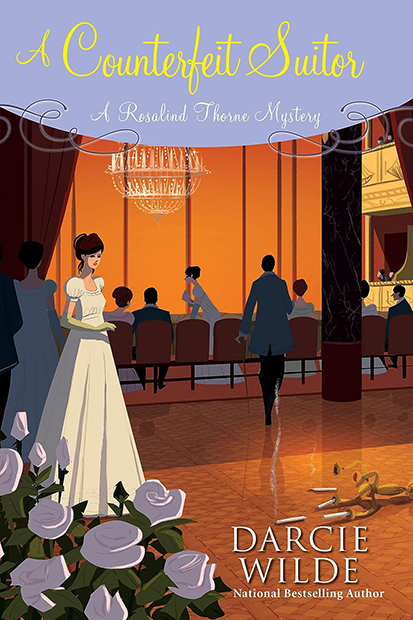
A COUNTERFEIT SUITOR: A ROSALIND THORNE MYSTERY (BOOK 5)
BOOK DESCRIPTION
Among the ton of Regency London, one breath of scandal can be disastrous. Enter Rosalind Thorne in this charming mystery series inspired by the novels of Jane Austen and compared to a 19th century Phoebe Waller-Bridge from “Fleabag.” Charming and resourceful, she is a woman adept at helping ladies of quality navigate the most delicate problems and privy to the secrets of high society—including who among the ton is capable of murder…
“Wilde’s heroine is not only a useful woman but a highly entertaining one.”
—Kirkus Reviews
It is every mama’s dearest wish that her daughter marries well. But how to ensure that a seemingly earnest suitor is not merely a fortune hunter? Rosalind is involved in just such a case, discreetly investigating a client’s prospective son-in-law, when she is drawn into another predicament shockingly close to home.
Rosalind’s estranged father, Sir Reginald Thorne—a drunkard and forger—has fallen into the hands of the vicious scoundrel Russell Fullerton. Angered by her interference in his blackmail schemes, Fullerton intends to unleash Sir Reginald on society and ruin Rosalind. Before Rosalind’s enemy can act, Sir Reginald is found murdered—and Fullerton is arrested for the crime. He protests his innocence, and Rosalind reluctantly agrees to uncover the truth, suspecting that this mystery may be linked to her other, ongoing cases.
Aided by her sister, Charlotte, and sundry friends and associates—including handsome Bow Street Runner Adam Harkness—Rosalind sets to work. But with political espionage and Napoleon loyalists in the mix, there may be more sinister motives, and far higher stakes, than she ever imagined…
- Publisher : Kensington
- Publication date : November 30, 2021
- Language : English
- Print length : 448 pages
- ISBN-10 : 1496720881
Buy the Book
Coming in 2026
Read an Excerpt
A COUNTERFEIT SUITOR — A Rosalind Thorne Mystery
by
Darcie Wilde
READER SAMPLE
PROLOGUE
Every trace of a gentleman is becoming effaced from his nature; he who was once, they say, one of the best dressed and most fashionable men about town!
Catherine Gore, The Debutante
Bath, December 1819
Sir Reginald Thorne’s head ached. The scents of the coal fire in the hearth and the burning candles on the table beside his desk wormed their way into his throat. It left him parched. He tried to focus on the half-written letter in front of him, but his vision would not stay steady. He knuckled his eyes and blinked hard, but it was no good.
“Get me my drink,” snapped Sir Reginald to the liveried servant seated beside the hearth.
“You’ve had your drink, sir,” replied the man without glancing up from the book he was reading.
“Well, bring me another. There’s plenty in this house, I know it.”
“I can bring, sir, a cup of tea, or chocolate, or coffee if he prefers, although at this time of night I would not recommend it.”
“If I’d wanted coffee, I would have asked for it. I said bring me a drink!”
The man sighed and turned a page of his book. He was a tall, raw-boned fellow dressed in good livery with a well-kept wig perched on his head. From the look of him, a person might assume this was the personal servant of an indulgent master. They would have been wrong.
A proper servant would have remained standing in a gentleman’s presence, no matter how late it grew. A proper servant would not remain insolently at leisure in a room when his master desires him heartily to be gone.
This man was a guard and he knew it, and Sir Reginald knew it. He was there not on Sir Reginald’s sufferance, but at his daughter’s orders. Those orders were to make sure Sir Reginald remained a captive.
Sir Reginald buried his head in his hands. It was hopeless. It had always been hopeless. Ever since his daughter Charlotte had brought him to this house and given him over to these men. His favorite child. The one person in the world he had believed would never betray him. He’d shared all the wonders of the world with her, depended absolutely on her companionship, and this is what she did to him. Turned whore and locked him up in this miserable little house in Bath, of all places! He who was welcomed at the tables of kings! Now he couldn’t even walk down the street on his own.
I never should have trusted her. I should have taken Rosalind with me instead.
No. Not her.
He still remembered what happened the last time he saw her. Did she open her arms and her heart to him as a grateful child should? Did her eyes shine with joyful tears to see her father had at last returned? Not she! Instead, she’d stood on the staircase, her face sick and white and so uncomely he could not in that moment believe they shared any blood at all. She did not lift a finger as her minions—her so-called godfather!—turned him away.
Damn, but he wanted that drink.
He glanced at the guard but gave it up as a bad business. The man would not see reason, as Sir Reginald knew from a hundred nights of trying to persuade, cajole, or, once—wretched memory!—even pleading. He could not be made to understand that when a gentleman had been through so many disappointments and betrayals, he should be allowed a gentleman’s solace. But no, the she-wolves Sir Reginald had sired were determined to withhold even that much from him.
“Daughters,” Sir Reginald sneered at his guard. “Leprosy would be less of a curse than daughters.”
“I’m sure you’re right, sir,” replied the guard placidly
“Haven’t any yourself, have you?”
“Not that I’m aware of.”
Sir Reginald felt his mouth twist into a bitter smile.
“Ready for bed, sir?” inquired the guard.
Truth was, he was tired, but Sir Reginald was in no humor to make things easy on his guard.
“I have this letter to finish. I’ll thank you not to disturb me.”
“Very good, sir,” he said calmly.
He picked up his pen, dipped it carefully in the ink, and addressed himself again to the letter he’d been writing. I’m not forgotten yet, he assured himself. Not yet. Even the she-wolves cannot get to all my friends.
He read the last line over:
I daresay you wonder at not having heard from me in so long, but I have been much abroad recently, recouping my health after having suffered from a bout of
Sir Reginald rubbed his forehead. What had it been? What could he say? He had indeed been ill, he knew that. Gravely ill. That was what caused these sweats and blurred his vision.
And still his guards kept away the wine and brandy that would strengthen him. This deprivation was, of course, the she-wolf’s doing. She wanted to keep him weak and confused. Unnatural being that she was.
illness, he wrote. However, I am now returned to England, and finding myself lodged at Bath, I
“What the devil?” muttered the guard.
Sir Reginald jerked himself around. He’d been so focused on the task of writing, he hadn’t noticed anything else. The guard was on his feet, the book tossed aside. He hurried to the window and pushed back the drapes. The light that entered now was strangely orange and flickering.
There shouldn’t have been any light outside at all. It was well past ten o’clock.
The guard struggled with the window latch and threw the sash up. At once, a wave of heat and the acrid smoke blew into the room.
“Fire!” The shout rang up from the street. “Fire!”
The guard at once bolted for the door. “Reynolds!” he shouted. “Morgan! Get to the pump! There’s a fire!”
“Fire!” came the shout outside again. “Fire!”
The guard ran down the stairs, leaving the door open behind him.
Sir Reginald laid his pen down. His heart was beating rapidly, but not from fear. The roar and crackle of the flames intensified. He stole softly to the window. The street outside was filling rapidly with people, some carrying buckets and others blankets. The smell of smoke grated on the back of his throat.
But here he stood in his little jail cell of a room, quite alone, with the door opened wide.
He listened. Below there was clattering and men’s voices shouting. It was hard to tell which of the noises came from inside and which from outside. His mouth had gone dry. His ears rang.
He was in his shirt sleeves and slippers, but he did not dare take time to dress. He ran for the boudoir and grabbed a jacket and pair of boots from the wardrobe.
What of money? Sir Reginald shook his head. He’d worry about that later. He still had his watch, the chain, his signet ring. He could raise money enough on those to get him started.
A drink. A ticket for the mail coach to London. Humiliating way to travel, but needs must . . .
Sir Reginald clutched boots and jacket to his chest and tiptoed to the door. He listened, straining his ears with all his might. His hand trembled. He clutched his bundle harder.
Nothing. That noise is all outside. Hurry!
As softly as he might, he stole down the stairs. Surely his guards had gone out the back way. Surely the foyer would be empty. Fate would be kind, this once.
A trickle of sweat ran down his temple, but he didn’t dare lift a hand to wipe it away. His throat was dry as dust.
Never mind. Never mind. A drink first. Then a ticket to London. My friends will remember me. The she-wolves will soon regret their treatment of their father.
There was the door.
His slipper toe caught the edge of the foyer carpet, sending him stumbling forward. He slammed up against the central table. The china vase tipped over, spilling water everywhere. He caught the vase before it crashed to the tiles, but dropped his jacket and boots. He stayed there in that ridiculous posture, holding vase and table, trembling and terrified.
No sound other came from inside the house. The racket remained safely outside.
Sir Reginald sucked in a breath. He released the vase and bent down to gather up his jacket and boots. Then, he bolted out the front door.
CHAPTER ONE — AN UNEXPECTED CALLER
“The vast extension of society in London…has necessitated a degree of caution in the formation of intimacy.”
Catherine Gore, The Banker’s Wife
London, December, 1819
#
“He says yes!”
Alice’s shout jolted Rosalind from contemplation of her latest piece of correspondence. So did the fact that her friend leapt to her feet and began dancing about the small parlor, waving a piece of paper over her head.
“He said yes! He said yes!”
“Is that a letter from Mr. Colburn?” asked Rosalind mildly. Alice Littlefield supported herself as a writer, a translator and gossip columnist. Last year, however, Alice had received an invitation from the publisher, Henry Colburn, to submit a novel manuscript.
“And he said yes!” Alice thrust the letter at Rosalind, and recommenced her exuberant dance.
Rosalind read:
Dear Miss Littlefield:
I trust this letter finds you in the very best of health. I am writing to inform you that I have finished reading the manuscript for Eversward, which you were so good as to submit for my consideration. I found the novel delightful in its entirety and I have no doubt the reading public will as well.
I should very much like to request the honor of calling on you at your earliest convenience to discuss matters relating to publication, so that we may put your excellent tale before the waiting world as soon as possible.
Your Obedient Servant,
Henry Colburn
“Alice, this is wonderful!” Rosalind got to her feet and embraced her friend. The two women were a study in contrasts. Alice was tiny, quick and dark, whereas Rosalind was tall, pale and statuesque with darkly golden hair and a pair of steady blue eyes.
“Of course, I knew he would accept,” Alice said loftily. “Being such an excellent judge of literary merit.”
“Of course,” Rosalind answered with perfect sobriety. The pair of them stared at each other for a full ten seconds before bursting into laughter. The fact was that in the month since she’d taken Mr. Colburn her manuscript, Alice had been scarcely able to sit still for five minutes all together. It was something a trial of their friendship, because at that same time, Alice had also moved into Rosalind’s house in Little Russell Street.
Alice fell back into her chair by the window. Rosalind’s small parlor had been made even more cramped by the addition of a table that was perpetually piled with Alice’s books and papers, not to mention her portable writing desk and assorted ink pots. Rosalind kept her desk with its neat stacks of correspondence, and account and visiting books beside the hearth.
“Oh, I can’t wait to see the look on my dear brother’s face when I tell him!” Alice crowed. “He was so set against the idea for so long.”
“You cannot entirely blame him,” said Rosalind. “It was a risky proposition. Your editor at the Chronicle could have taken offense.”
“Never. The Major was thrilled when I told him. The possibility that his gossip column might now be written by a “celebrated novelist,” has him counting new sales in his sleep.” Alice grinned broadly. “We must celebrate, Rosalind! Where shall we go? What should we do?”
“I’m so sorry, Alice, I can’t tonight. I must keep my appointment with Mrs. Walford to attend the opera.”
“Oh! It’s the season opening! This letter from Mr. Colburn drove it right out of my head. Have you heard from Sanderson yet?”
“This is his letter here.” She held up the piece of correspondence. “He reports that he was entirely successful in his errand, and will meet me in the salon tonight.”
Like Alice, Rosalind lived in what was frequently termed “distressed circumstances.” Her life had begun promisingly enough. She was the younger daughter of a charming baronet who was a prized as a party guest by all the best hostesses. Her mother had charted her course through London’s social networks with a skill that got her into the visiting books of some of the city’s most prominent ladies. Rosalind had even attracted the attention of Devon Winterbourne, the younger son of the Duke of Casselmaine.
Then it had all gone wrong. Rosalind’s charming and delightful father had fallen into debt. Sir Reginald has always gambled, but debt tempted him deeper into gaming and speculation. When none of this was enough, and his friends began to turn away his begging letters, he turned to forging letters of credit.
At last, unable to find his way out of he morass he made, her father fled. He left behind nothing but the ashes of burnt dunning notices and a letter assuring his wife and youngest daughter of his eternal love.
His oldest daughter, Charlotte, he took with him.
It had been too much for Rosalind’s mother. She had supported Sir Reginald with every ounce of her energy, and he had abandoned her. Her nerves snapped. When she died, Rosalind was left to make her own way.
With help from her mother’s friends, Rosalind learned to apply her talent for organization and her understanding of London’s social world to help these ladies of the haut ton manage their households, and their seasons. Gradually, she developed a reputation for being a useful woman for the ambitious hostess to know, and cultivate. This allowed her a genteel, if frugal, living and kept her at least on the periphery of the world in which she was raised.
Two years ago, however, Rosalind’s world had changed again. A murder had occurred at the most improbable location — the ballroom at the famous Almack’s Assembly Rooms. Rosalind was engaged to make sure no taint of scandal became attached to the assembly rooms, or to its famous patronesses. In the end, Rosalind had done this, and discovered the murderer as well.
Now, Rosalind continued her life as a “useful” woman, but the requests for help with particularly delicate matters became more frequent. She found herself consulted by a number of powerful families of London who wanted, or needed, to be preserved from scandal, and even prison.
It was in this capacity she was engaged to attend the opera this evening.
“You know, Rosalind, I’ve been on the verge of becoming annoyed with you about this current business of yours,” Alice said. “You have been more than usually secretive about it.”
“I’m sorry, Alice. The truth is, I’ve been rather uncertain about it all.”
Alice detected the change in Rosalind’s tone, and the light in her eye. “Well, perhaps if you’d tell me what it is…”
Rosalind smiled. “I will, and right now, because I’m going to need your help. You see, about a month ago I was approached by a Mrs. Walford, on the recommendation of Mrs. Gregory. Mrs. Walford said she wanted to give a charity ball to raise money for the widows and orphans of the late wars, before before the ton scatters for Christmas.”
“But what Mrs. Walford really wanted…” Alice leaned forward eagerly.
“Was for someone to look into the background of a young man her daughter had met,” said Rosalind. “Mr. Horatio Salter.”
“Oh wait, this was the man we came upon so conveniently at the Mrs. Holding’s private concert last month? The concert you suggested that George and Hannah and I should attend with you?”
“It was also where George was so enormously helpful in getting Mr. Salter talking about all his school chums.”
“And you immediately set about seeing which of the sisters and mothers of those school chums you were acquainted with, so you could start asking leading questions about Mr. Salter?”
“Exactly,” said Rosalind. “Miss Augustina Walford is an heiress, not on the heroic scale, but respectable. The family is from Manchester, so they do not have the connections among the London ton to thoroughly inquire into a suitor’s background for themselves. This leaves them vulnerable to fortune hunters.”
“Not to mention the fact that the London ton will surely look down their very long noses at any Manchester soap manufacturer seeking advice.”
“Gingham,” Rosalind corrected her. “And yes. Despite the fact that Mrs. Walford was raised in London, the family has received all the usual snubs. That is part of what the charity ball is meant to assist with. In the meantime, I have been able to unearth a number of salient facts about the man who wishes to ensnare Miss Augustina Walford.”
Rosalind pulled a stack of letters out of her desk. Alice took them and scanned the pages quickly. “Oh, Rosalind! I mean, I expected debt, but…he was part of the 1814 stock fraud?” The fraud had been a major scandal. It started with a rumor in a coffee house saying Napoleon was dead. That rumor had spread and mushroomed into a stock buying spree that had cost the public millions of pounds, ruined whole families, and nearly crashed the entire market.
“A minor player, but yes, he was instrumental in spreading those initial rumors.”
“Well that seems all very straight-forward.” Alice leafed through the letters. “He’s a fraudulent fortune hunter, and mother’s instincts have saved the day. What is it that’s made you uncertain?”
“I don’t know,” Rosalind sighed. “It’s something about Miss Walford herself. She shows all the signs of being attached to Mr. Salter, but there’s a way she looks at him, and at me sometimes, like she’s suspicious.”
“Could she have guessed that you’re checking up on her fiancé? If my mother did any such thing, I would have been furious!”
“I know. I just wish I felt more certain. There’s something at my fingertips, but I can’t quite get hold of it.”
“Well, you will,” said Alice. “You always do. Perhaps it will happen tonight.”
“Yes. It very well might. The plan is that Sanderson Faulks and I will be creating a small scene at the Opera, one that will involve Mr. Salter. I hope, A.E. Littlefield will write up the incident, and include mention of some shocking information —” Rosalind tapped the letters in Alice’s hands “— that has come to his attention.”
“Well, as delighted as I’m sure the Major would be to unearth a member of such a notorious fraud, shouldn’t this go to Bow Street? Or even Parliament?”
“Unfortunately, what we have is rumor — repeated rumor, but rumor all the same. Coupled with what has been confirmed about Mr. Salter’s debts and gaming habits, I’m sure it is true, but I don’t have definite proof yet. I’m hoping that will come next.”
“I’ll get these to George right away,” said Alice. Like Alice, George wrote for the Chronicle, but was generally assigned to what Alice referred to as the “richer” stories. “He can write the main article. It will be a change from writing about Bonapartists.”
“Bonapartists?”
“Yes. It seems England and France are both absolutely riddled with secret societies of Bonpartists. All with terribly dramatic names — the Carbonari, the Friends of This, the Society of That, The Congregation…oh, no wait, those are supporters of the Bourbons…anyway, the country is full of such societies, half of them are dining at Holland House and trying to get motions passed in Parliament. The other half is sending money to his brother in Philadelphia, or is it Mexico now?”
“Whose brother?”
“Napoleon’s! His brother Louis is settled in America, working on fomenting revolution and setting his brother up a new empire just as soon as all these secret societies manage to get him off St. Helena’s. There was talk of a hot air balloon, but that seems to have gone nowhere. The submarine is apparently rather more promising. Although, if I were to place a bet, I’d favor the corsairs who are being outfitted in Argentina. Honestly, Rosalind, don’t you read the papers?”
Rosalind could not tell from her friend’s face whether Alice was serious about any of this. “Forgive me,” she said blandly. “I’m afraid I’ve been rather busy of late.” Since summer, she had been answering an increasing number of pleas from ladies who wanted her help. The benefit to their household budget was measurable, but it was taking a great toll on Rosalind’s reserves of energy and concentration.
“Yes, of course,” said Alice. “Well, as I say, I will get these to George, and I’m sure he’ll appreciate the change. Not a secret society in the bunch.” She waved the letters like a fan but then, some motion outside the window caught her eye. “Rosalind, were you expecting any calls today?”
“No. No one.”
“Well, there’s a lady hurrying up to your, that is, our, door.”
Rosalind came to her friend’s side and looked out the window. A slender woman in a plain, dark coat and a broad, concealing bonnet with plenty of lace trimming was walking up the street, and mounted the steps to Rosalind’s door.
It was impossible to see her face from this angle, but Rosalind’s breath grew short anyway.
Why would she come here?
A moment later, the new housemaid, Amelia, came into the parlor. “A lady to see you, Miss Thorne. She sent this in.” She held out a card. “She said you would know her.”
Rosalind took the card without reading it. “Yes. I know her.”
“Rosalind?” began Alice, but Rosalind shook her head. Alice would see soon enough who their visitor was. Right now, she could not trust herself to speak.
The parlor door opened and the maid stood back to let their visitor enter. Rosalind rose slowly to her feet. Alice openly gaped.
The woman was a bit older than Rosalind, and thoroughly out of breath. Her dress was plain, but its blue woolen fabric and cream trim were of the highest quality. Its skirt was fuller, and its waist was lower than current fashion, hinting that changes in the mode were soon to come. Her honey-gold hair was simply but stunningly arranged. Her face was a perfect, pale oval, and she was tall enough to look Rosalind directly in the eye. But where Rosalind’s form was generously curved, this new arrival was slim as a willow wand.
Her clear blue eyes, though, were were strikingly similar to Rosalind’s own.
“Hello, Charlotte,” said Rosalind to her sister.
“Hello, Rosalind,” replied Charlotte. “Hello, Alice.”
“Charlotte.” Alice swallowed. “This is…a surprise.”
“Yes. I’m sorry. But something…it’s very urgent.” She hesitated. “Rosalind, I think we had best speak in private.”
“There’s nothing you can say that Alice can’t hear,” said Rosalind. Her sister’s cheeks were pale, and there were dark rings under her eyes. Rosalind felt her chest tighten with sudden fear. “What’s happened?”
“It’s father,” Charlotte said. “He’s escaped me.”
The Importance of Independent Book Shops

IndieBound is a “local first” shopping movement and a network of hundreds of independent bookstores sharing book recommendations and connecting readers and authors.
Independent bookstores have always occupied a special place in communities. Through IndieBound — and the Indie Next List fliers and Indie Bestseller Lists — readers find trusted, bookseller-curated reading options, newly discovered writers, and a real choice for buying.